Uruguay is a unique country amongst its region. Many countries in South America have endured tumultuous histories of dictatorships, social crises, American-backed intervention and subsequent instability. As a result, following the global trend, quite a few South American countries are falling into extremist governments. However, as the New York Times reports, Uruguay “is not a country of extremes”—it is one where the lines between left and right governments are blurred, in which transitions have been smooth and internal cooperation has led to progressive advances which benefit all. However, the election of its new president may bring some extremism into Uruguayan politics.

Luis Lacalle Pou of the center-right National Party was elected in November of last year. His administration follows a fifteen year period center-left government control. This government was responsible for progressive measures such as the legalization of recreational marijuana, gay marriage, and abortion. However, the government never adopted the extreme leftist policies found in Venezuela or Nicaragua. Many hope that likewise, this right-wing government will not be of the extremist kind—such as the authoritarian Brazilian or Guatemalan governments—and instead, follow Uruguay’s moderate tradition.
The threat does not come from Lacalle Pou’s own National Party, but rather from the alliances he had to form in order to win the presidency. The president allied with four other parties which he will have to work with and negotiate with throughout his administration. In Uruguay, you must keep the alliance firm in order to keep a majority in parliament. The party of concern is Cabildo Open. Led by retired general Guido Manini Ríos, speaks in nationalist terms and holds some far-right views. For example, he thinks that Venezuelan refugees get too many benefits, and wants to maintain “family values” as he sees the country is in a “cultural crisis”, in reference to the legalization of marijuana and abortion. Ríos published a video in which he told the military not to vote for the left. Lacalle Pou later clarified that he did not agree with Ríos’ statement.
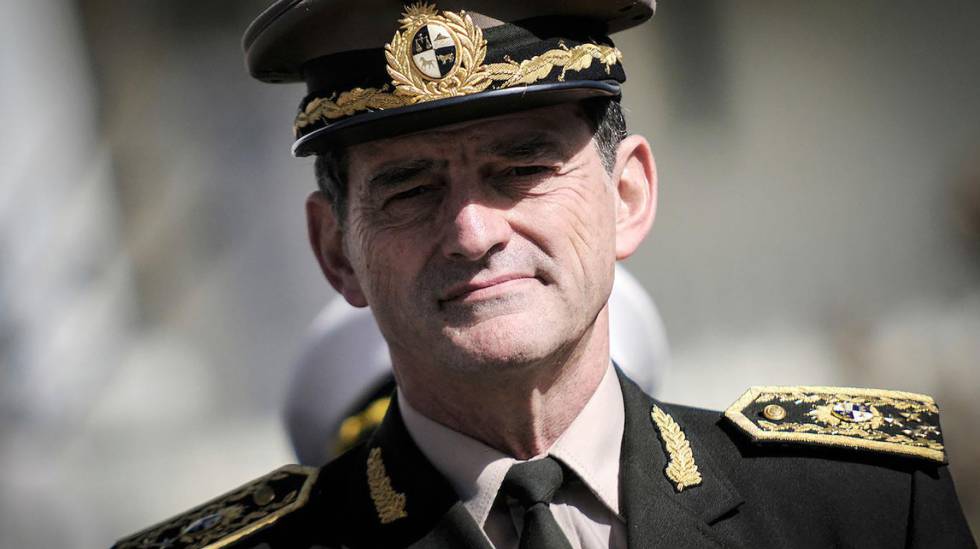
Image source: https://elpais.com/internacional/2018/09/20/america/1537405953_581619.html
The challenge Lacalle Pou will have to resolve is keeping harmony between the five parties in his coalition, avoiding polarization and maintaining a good relationship with the opposition as well as moderate Ríos’ more extreme leanings.
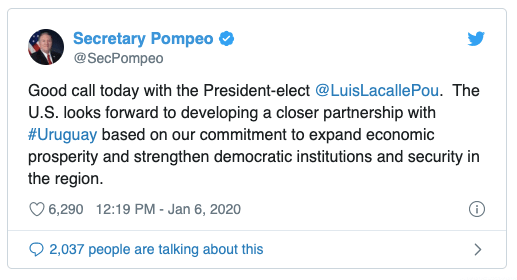
As to foreign policy, Lacalle Pou spoke with U.S. Secretary of State Mike Pompeo on a phone call earlier this year in January. Both tweeted about their conversation, announcing their enthusiasm about strengthening their countries’ relationships and expanding economic opportunities. The State Department stated, “Secretary of State Michael R. Pompeo spoke today with Uruguayan President-elect Luis Lacalle Pou to congratulate him on his victory in the November 24 presidential elections. Secretary Pompeo and President-elect Pou discussed expanding bilateral economic engagement and deeper cooperation on resolving the Maduro-made humanitarian crisis in Venezuela. The United States looks forward to developing a closer partnership with Uruguay based on our shared commitment to strengthening democratic institutions and security in the region”.
Unlike the past three administrations in Uruguay which supported Venezuela’s leaders Hugo Chavez and Nicolas Maduro, the new administration and its coalition see the Maduro regime as a dictatorship that has “eliminated oppositions parties, gagged the media and openly violated human rights plus causing a worsening humanitarian crisis”.
Regarding the Fragile State Index, Uruguay has a 2019 score of 34.0 and ranks 158th. It is considered very stable, and shares that rating alongside countries such as the United states, France, and South Korea. Its score has improved as it decreased by 1.4 points. Since 2013, Uruguay’s score has continued to decrease. The moderate and cooperative government is a likely contributor to its healthy score.
 South America