Chile is a South American country that has endured many economic and social hardships. However, one might not realize that solely based on their primary media coverage, known as The Santiago Times (Visit SantiagoTimes.cl!). This is a website from the country itself, most likely regulated by the people with the most power and control in the country. On this website, we can see how the country is viewed as prospering, with tabs saying things like “Chile opens public consultation period for two marine parks,” or “Chile announces measures to become a regional financial center.” Both of these can be seen as positives and most likely are happening to some extent. When examining Chile from another news source that is not regulated by the country itself, one can see what is truly happening in Chile.
Let us take The Independent’s, a United Kingdom website, coverage on Chile as an example (Visit Independent.co.uk!). Under the “Americas” tab on the site, the first coverage on Chile is an article titled, “Beaten, mutilated and forced to undress: Inside Chile’s brutal police crackdown against protesters.” It goes on to explain how the government officials are abusing their powers by torturing protesters and sexually assaulting women. Women are being forced more than men to undress in front of men that work for the police department. They are forced to do some sort of a “search,” as if there are dangerous weapons on these protesters. Men are not having to do this as much as women are, showing sexual misconduct is happening throughout the area.
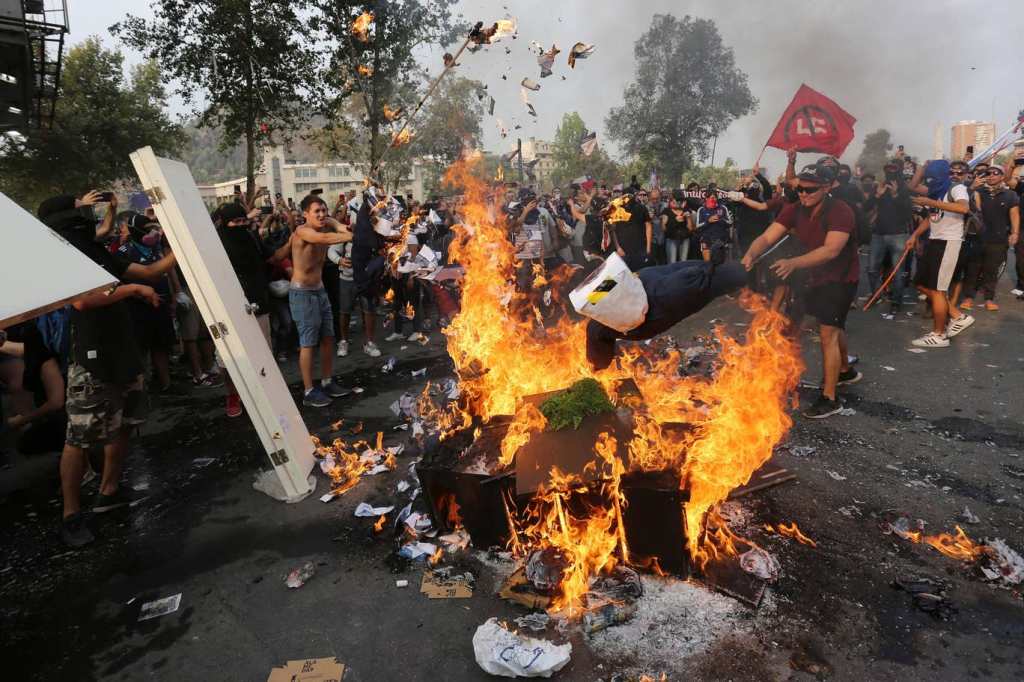
Not only was this hard for the protesters to endure, but the conditions of what happened when they were arrested and put in jail were even worse. They were given little to no food or water, beaten several times throughout the whole experience, and given zero medical attention even though it was the law enforcement in the first place that hurt them. The article also goes on to explain that there are over 1,000 judicial actions against Chile authorities along the lines of rape, torture, and even homicide. People are standing up to fight against these tyrant actions and are additionally getting hurt along the way to change it. The only way one can go about trying to solve this problem is by fighting it at the core, which is precisely what the people of Chile are trying to do. However, when the problem itself is the one you are supposed to go to for help, then it can be tough to get change.
Switching to a more economic view of Chile, the country is way more stable than it was let us say ten years ago. According to the Fragile State Index, the country is at the higher end of the stable region, almost making it into the sustainable group (Visit FragileStatesIndex.org!). It also shows that, based on that ranking, it is ranked 28th in the world, trailing the United States of America at 25th. Chile has become very economically rich in the past few years because, at one point, it was known to be very poor and unstable. The region can now support itself more than it could in the past, which means many more jobs and improvements to the country. But, with the up-rise of these riots and protests, the economy will most likely decline. People fuel the economy, and when the people aren’t happy, they aren’t buying and fueling it to its full potential.
“Riots have rocked Santiago for a month in the biggest crisis to hit Chile since its return to democracy in 1990. Weeks of unrest have stifled the economy, prompting increasingly grim forecasts for growth and unemployment”
-MercoPress (Visit SantiagoTimes.cl!)
The rise of democracy and trade has helped bring more money into the region. However, just because the country is excelling economically at the moment, we can still see how much needs to be done socially and politically. People are being silenced by no coverage in their own region’s media coverage, which can be very dangerous. Luckily, examining multiple media outlets can show how Chile is fundamentally functioning as a whole. The region is strong in some aspects while weak in others. Social and Political reform is what Chile desperately needs in order to have a fair and functioning community.
 South America