Uruguay Post #2
Languages of Uruguay
In order to understand the languages of Uruguay, it is important to examine its history and ethnic populations. Today, the ethnic demographics of Uruguay are largely homogenous—87.7% are of European ancestry, 4.6% are of mixed African ancestry, and 2.4% are of mixed indigenous ancestry. Originally settled by the nomadic Charrúa people, the population was wiped out by early European settlers. While disease and intermarriage weakened the native population, it was ultimately the aborrent genocide, called La Campaña de Salsipuedes, that erradicated the Charrúa in 1831. Although the European settlers first had good relations with the tribes, Uruguayan President Fructuoso Rivera later betrayed the Charrúa in favor of the Europeans’ desire to expand and the resulting increasing tensions. All but 300 of the Charrúa were murdered, and the remaining were sold as slaves. One native partial-speaker of Channá, a language of the Charrúa people, remains today. Montevideo
Although the Portuguese were the first to settle in Uruguay in 1680, Spain established the first stronghold in Montevideo and Spanish prevailed as the main language. Today, 99% of the population speaks Spanish, and it is the official language of Uruguay. Waves of immigrants from Spain, Italy, Switzerland, and Russia arrived throughout the 18th and 19th centuries, and small communities still speak their native languages which include Italian, Catalan, German, Plautdietsch, and Yiddish. Studies show that 60% of Uruguayans have a Spanish ancestor and 40% an Italian ancestor. Uruguayan Spanish is strongly influenced by Italian, with Italian words incorporated into the language as well as having an effect on the accent.
Global Relations
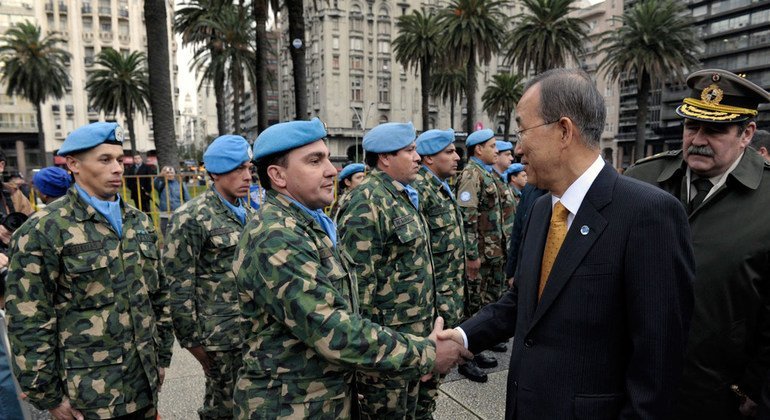
Uruguay has been a member of the UN since 1965, when it joined as a founding member. As of 2013, it has the highest per capita troops contribution to Peace-Keeping Operations of the UN.
Uruguay has been a member of the International Monetary Fund since March 11th, 1946. Uruguay received a $2.28 billion loan during its 2002 economic crisis to help establish a better macroeconomic framework and reestablish confidence in banks to provide lasting stability.
Uruguay joined the World Trade Organization on January 1st, 1995. The Uruguay Round, the eighth GATT (General Agreement on Tariffs and Trade) round, was launched in Uruguay in 1986. It led to the creation of the World Trade Organization, and was the biggest world reform on trade since the GATT was formed.
Uruguay ranks 63rd on the Gini Index out of 159 countries. It has a score of 39.50 as of 2017. Uruguay’s score peaked at 46.40 in 2007, but has been on the decline with its lowest score being its most recent one in 2017. This indicates that equality is increasing.
Uruguay has a GDP of $59.60 billion, ranking 80th of 185. Uruguay ranks 59th of 185 with a GDP per capita (or PPP) of $23,274.
Current Events
February 6th: Nike has changed its business model in Brazil, Argentina, Chile and Uruguay. While it previously operated with Nike-owned assets in these countries, it is now selling those assets to local distributors. Grupo Axo will acquire Nike’s operations in Uruguay. Nike stated that consumers shouldn’t see a change, and that it is utilizing a business model it has already put into practice throughout other regions. This transition is part of Nike’s Consumer Direct Offense, a large-scale program designed to get products on the market quicker and increase direct sales.

February 5th: Centurion Minerals acquired 100% of assets and shares held by CannaEden in exchange for common shares of Centurion. Centurion Minerals is a Canadian company looking for asset development in South America. CannaEden is a group of Uruguayan companies with over 20 years experience of cultivating cannabis. The business plan following the acquisition aims to 1) cultivate cannabis suitable for extraction for use in consumer products and 2) produce an API (Active Pharmaceutical Ingredient, or the part of any drug that produces the intended effects) for pharmaceutical companies.
 South America