Post #3
Chile’s State of Equality and Nationalism
Nationalism, as described by Freed Zakaria, the author of The Post-American World, is “the rise of pride and confidence in one’s country” (Zakaria 34). This can be related to Chile, but sadly not in the way one would hope. Chile is still on the brink of its protests against the government for cruel and unfair treatment. Nationalism is when someone is happy about one’s country, and the citizens of Chile are not happy with theirs. They are lashing out against the government for using anti-democratic actions and inequality. The people of Chile want to adopt new world ideology, and the government is resenting these actions, putting the people in a hard place where they must take action for themselves.

Another thing that Zakaria discusses the rise of nationalism throughout the world is it will make it harder for America and other world leaders to keep all the power and have influence throughout it. This is also a very similar philosophy Manfred Steger takes, the author of Globalization. Steger talks about how countries with decreasing dependence start to set up their own political and economic agendas, leaving little room for others imperialistic countries to come in and take over. People becoming solely invested in their country and government means it will be harder for another country just to come in and do whatever it wants — people like what they have and do not want it to change. Influencing will no longer be useful, and power will be more evenly distributed than it was a few years ago. Chile can be seen as having little to do power at this time because, with all the torture and cruel behaviors, the government is currently inflicting leave the region vulnerable to outside influence.
The nation-state problem can be observed in countries to this day, including the United States. Chile is experiencing a conflict with nation-states to this day with ethnic problems with the Mapuche people. The Mapuche are indigenous people that had lived there long before modern influences arrived in the region (Visit chileaphg.com!). They are losing their lands to things like logging and farming companies. This can be seen as a problem happening all around there world, like the Native Americans throughout the United States (Steger 29), where infrastructure and technology are taking over everywhere, not caring who or what is in its path.
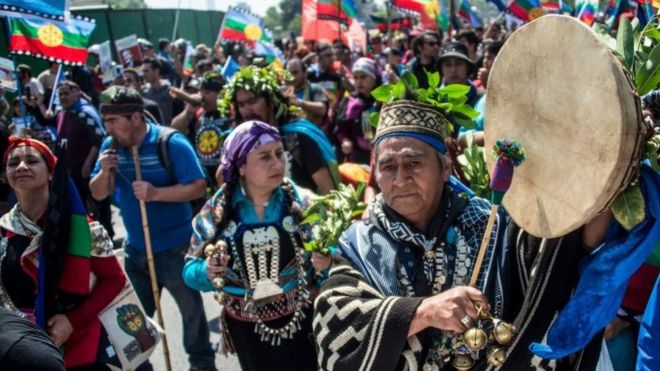
The inequality that officials are giving is very apparent to anyone that has some sort of common decency. Things like making women undress in front of male officers because they think they have “probable” cause to do so. Others were arrested for little to no reason, then put away without food or water for hours. They have tried to do things like decrease health care wait time and medication prices, but the people still want more (Visit aljazeera.com/Chile!). They want democracy and equality like the rest of the world is becoming. They all want to be a part of a fair and equal society. All these protesters are trying to achieve is fair treatment from the people that are supposed to protect them.
The worst part about these things, like the Mapuche people and the riots for equality, is that the region’s primary news source, The Santiago Times, is still not reporting on any of these problems at all (Visit SantiagoTimes.cl!). Reporting on this country for more than two weeks now with the same problems has concerned me, but when I return to this website each time, still nothing about it is being reported. If one wishes to see anything about these issues, you must go to a privately run website or a third-party website to see many articles about these protests. It is very frightening that the country is doing this to their people, and the only thing they can do is fight for it. The world should be aware of this dilemma and should possibly be ready to intervene if things continue to go south for the citizens of Chile.
References:
Zakaria, Fareed. The Post-American World: Release 2.0 ; Updated and Expanded. W.W. Norton, 2011.
Steger, Manfred B., and Paul James. Globalization: the Career of a Concept. Routledge, 2017.
 South America