POST #5
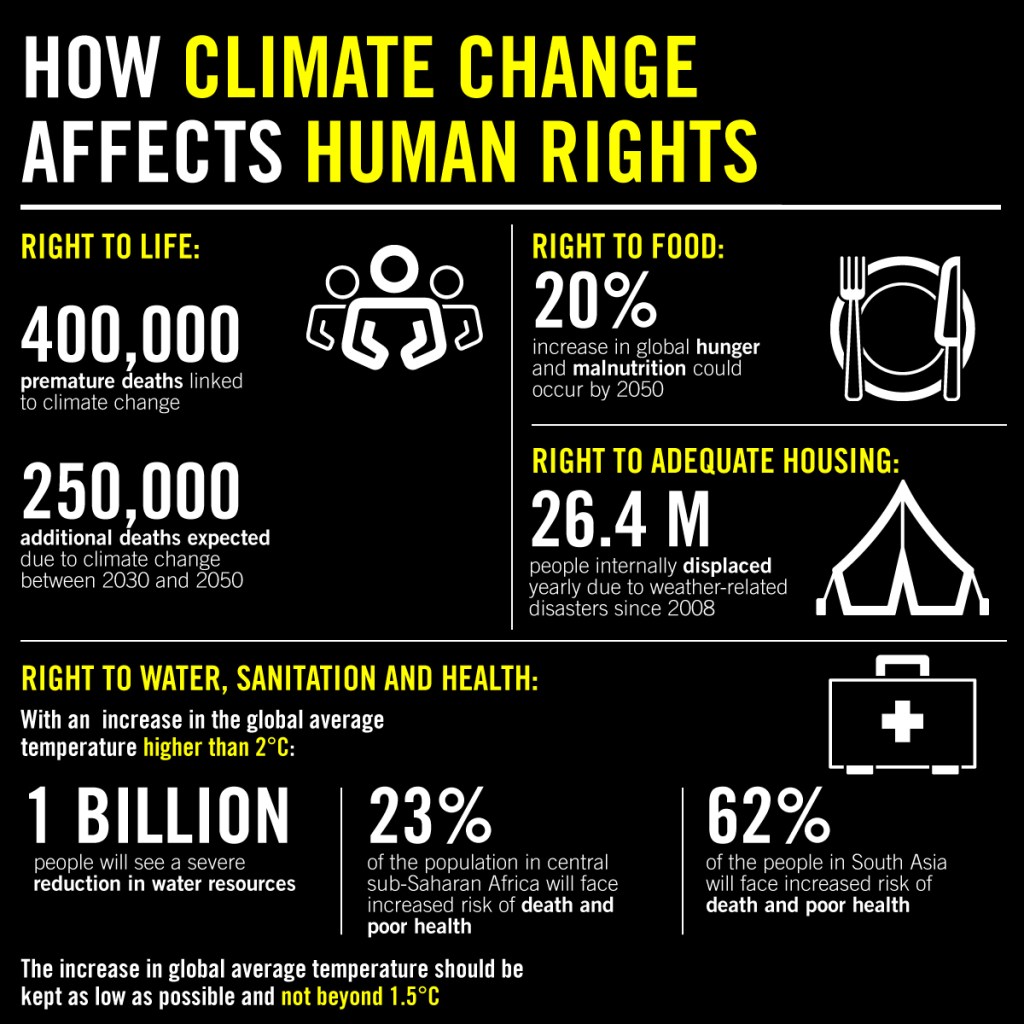
Climate change is one of the greatest threats to human rights of our generation, posing a serious risk to the fundamental rights to life, health, food and an adequate standard of living of individuals and communities across the world. This report aims to support government and private decision makers by assessing the relationship between climate change and human rights law.
Climate-related deaths are caused by extreme weather events, heat waves, floods, droughts, wildfires, water-borne and vector-borne diseases, malnutrition and air pollution. The climate crisis threatens the right to water and sanitation, contributing to water crises like the one in Bolivia, where glaciers are receding, and water rationing has been required in major cities. At 2°C, 100 million more people are forecasted to face water insecurity.
The negative impacts caused by climate change are global, contemporaneous and subject to increase exponentially according to the degree of climate change that ultimately takes place. Climate change, therefore, requires a global rights-based response. The Human Rights Council (HRC), its special procedures mechanisms, and the Office of the High Commissioner for Human Rights have sought to bring renewed attention to human rights and climate change through a series of resolutions, reports, and activities on the subject, and by advocating for a human rights based approach to climate change. The Preamble of the Paris Agreement to the United Nations Framework Convention on Climate Change makes it clear that all States “should, when taking action to address climate change, respect, promote and consider their respective obligations on human rights.”
Environmental issues in Venezuela include natural factors such as earthquakes, floods, rockslides, mudslides, and periodic droughts.
Venezuela ranks among the world’s most ecologically diverse countries, having for example, numerous bird species (avian biodiversity).However, it has suffered great environmental degradation. It has the third-highest deforestation rate in South America, at 2.1 percent.
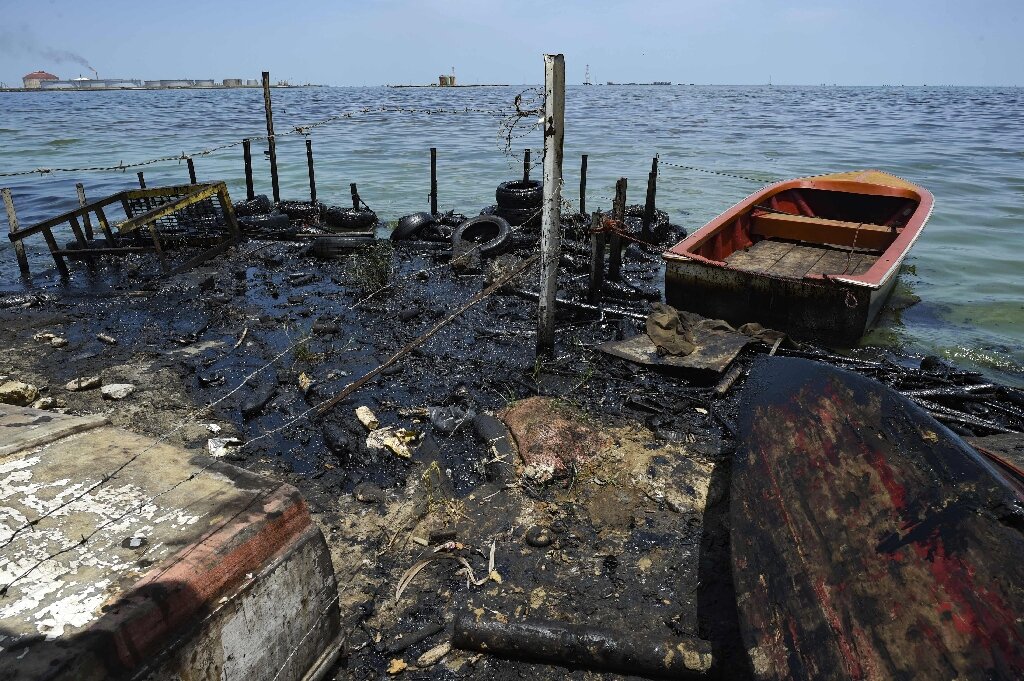
Environmental issues include sewage pollution into Valencia Lake, oil and urban pollution of Maracaibo Lake, deforestation, soil degradation, and urban and industrial pollution, especially along the Caribbean coast. Current concerns also include irresponsible mining operations that endanger the rain-forest ecosystem and indigenous peoples. Successive governments have attempted to develop environmental regulations. However, only 35 to 40 percent of Venezuela’s land is regulated thus far, 29 percent as part of national parks.
Many of the lands that are being aggressively exploited are home to indigenous groups, who are often deprived of their livelihoods and means of survival. Alternative survival strategies often mean participating in illegal mining economies as the national currency rendered nearly worthless by hyperinflation has led to an acceptance of gold as an alternative to cash, or joining the non-state armed groups that run the regions rich in minerals.
The political, economic, human rights, and humanitarian crises in Venezuela combine to compel Venezuelans to leave and make them unable or unwilling to return. Some qualify for refugee status. Others do not, but would face severe hardship if returned to Venezuela and are in urgent need of humanitarian assistance in the countries to which they have migrated.
Many Venezuelans in other countries remain in an irregular situation, which severely undermines their ability to obtain work permits, send their children to school, and access health care. This makes them vulnerable to exploitation and abuse.
Watching the TED talk of Elizabeth Lindsey, I found it very compelling. I agree with everything she said. The world really needs to remember its way back home, remember that we are enough and remember that we are children of the gods. Get the true seriousness of its spiritual essence to be freed in oneself to attain fulfilling happiness thus achieve it through the world. We must preserve and understand our culture in order to achieve completeness.
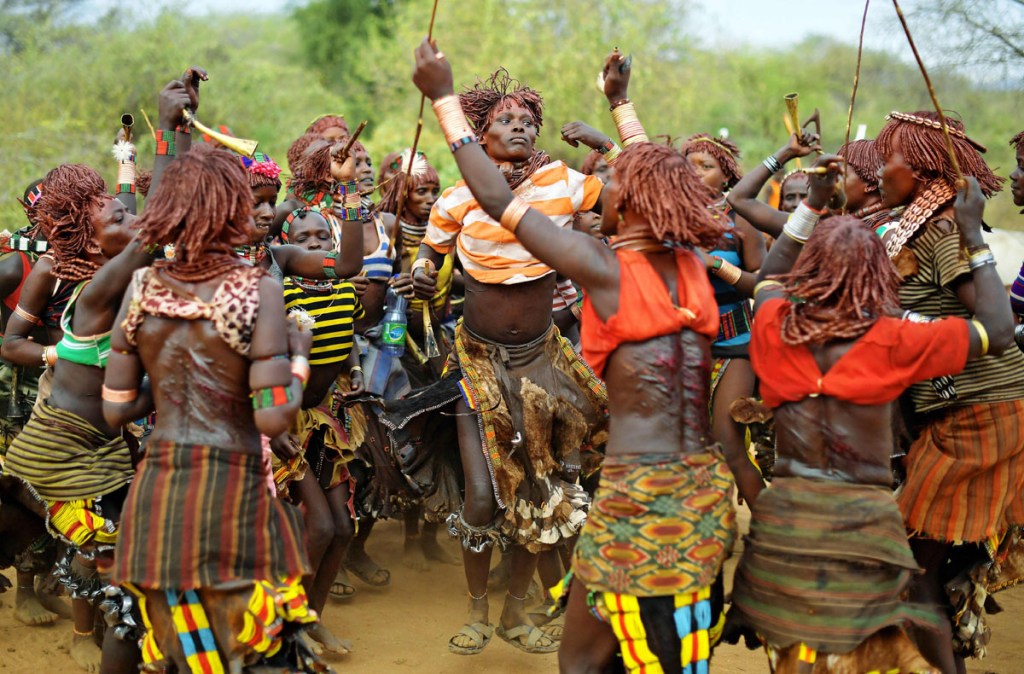
Endangered cultures refers to the threatened extinction of these in indigenous societies. The concept of endangerment first appeared in publications in 1990. Endangerment begins when society’s youth no longer learn and use their traditional language and culture, or are prevented from doing so. Various factors can cause this to happen, particularly colonialization and later globalization.
There are an estimated 15,000 cultures remaining on earth, many doomed or significantly threatened by erosion of cultural integrity, loss of habitat and environmental quality, and the ravages of disease and socio-economic infections. With them goes expertise and wisdom of elders, healers, midwives, farmers, fishermen and hunters, mostly transmissible only by oral tradition to respectful successors.
I agree with what Wade Davis says on his TED talk. The preservation of tribes’ traditions and works is very important for our world. Indigenous people are closer to earth than most humans beings are because they have a big and strong bond to it. Sometimes, we really don’t care about the environment, but indigenous people really do care. They got everything they need from the nature and they take care of it. So, with environmental issues not being resolved, we’re just basically denying their humans rights.
In “Beyond Eurocentrism,” Farish Noor defines eurocentrism as “the emerging perception within the European cultural, historical experience of European identity as good and all other forms as less good or less advanced.” When Noor talks about “going beyond eurocentrism,” he means seeing the world without Europe being the norm or the medium that other countries and communities are compared to. Some places, such as Asia, have morals and values with origins that are completely different from those of Europe, but they are still compared to these places that have nothing to do with their ideas. Noor says if we get rid of this idea that Europe is the center of civilization, we may have a chance at better understanding where one another are coming from.
Eurocentrism is generally defined as a cultural phenomenon that views the histories and cultures of non-Western societies from a European or Western perspective. Europe, more specifically Western Europe or “the West,” functions as a universal signifier in that it assumes the superiority of European cultural values over those of non-European societies.
References:
https://www.ohchr.org/EN/Issues/HRAndClimateChange/Pages/HRClimateChangeIndex.aspx
 South America